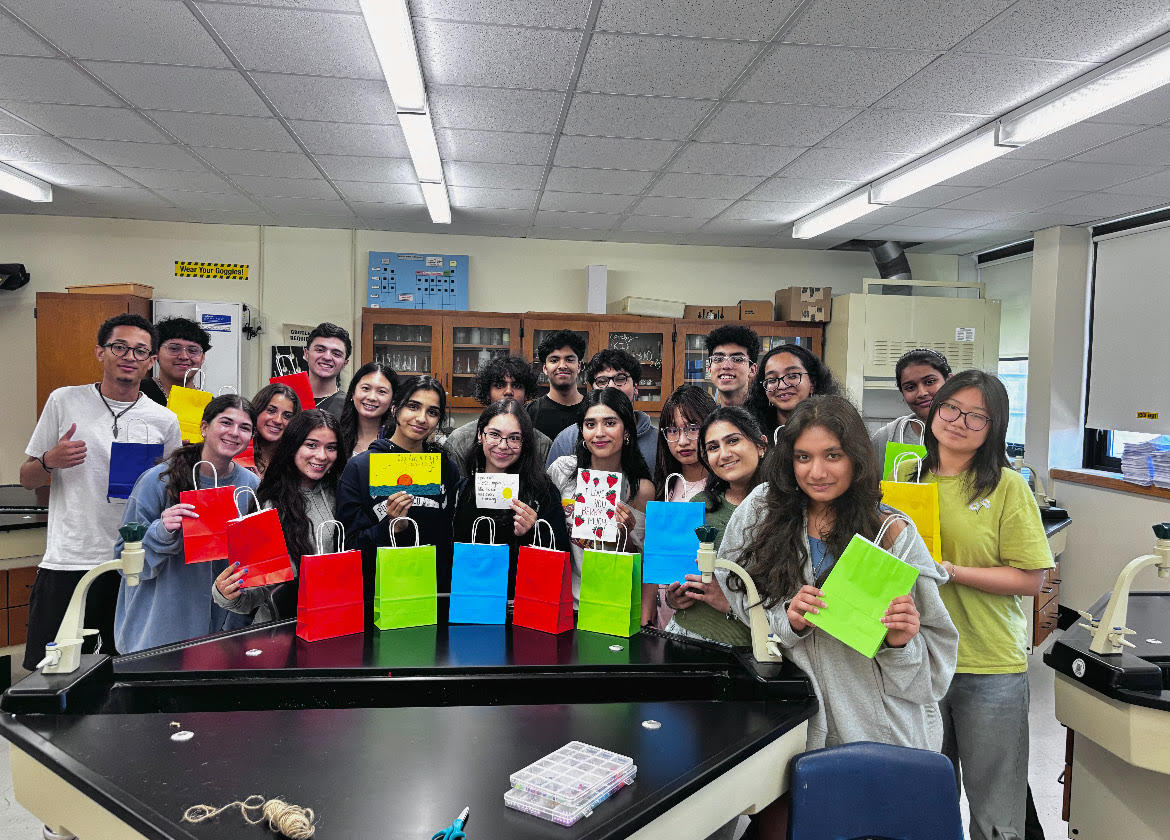
An EMT provides out-of-hospital care for critically ill or critically injured patients. Last year, a form was sent out to juniors asking if they would be interested in signing up for an Emergency Medical Technician or EMT class at Bethpage High School. The description mentioned 3-hour classes, twice a week for eight months. 12 students signed up. This opportunity allowed students with interest in the medical field and emergency services to obtain their EMT certification through the Nassau County Emergency Medical Service Academy. TEC interviewed the certified instructor coordinator Peter Shanhai.
TEC: Hi, could you tell us a little bit about yourself and the EMT course?
Mr. Shanhai: My name is Peter Shanhai, and I am a certified coordinator of this EMT class and this class is amazing because of two reasons. The first reason is that we’re having it done in a high school, which is very exciting, and the second reason is that New York State changed the age limit from becoming an EMT from 18 years old to 17 years old.
So I am excited about the course. Now, the great thing about this course is that if you want to become an EMT, a paramedic, a registered nurse, a physician’s assistant, or a doctor, this is where you need to start out. I say that, because this will be your first taste of pre-hospital medicine and it’ll really show the students exactly what they’re looking forward to later on as their careers progress.
It’s a great thing if you could handle the EMT course, enjoy the course and enjoy interacting with our patients or our students that are pretending to be patients. If they can do that and have compassion for them, this license will really open a door for them into a medical career. So that’s kind of like what this course is about.
You will also be able to get a New York State Department of Health license, which is pretty cool for a 17 year old, I would think. So that’s why I think we’ve formulated this course. That’s one of the reasons, or several reasons, I should say, why I like teaching this course.
TEC: Yeah, that’s way cooler than a driver’s license.
Mr. Shanhai: Yes, see, I would think so.
TEC: So what drew you to the EMT field in the first place?
Mr. Shanhai: Wow, that’s a great question. All right, so when I was 16-17 years old, I went to Far Rockaway High School and I wasn’t 100% sure what I wanted to do at that time. I knew I was interested in medicine, but I also knew that my parents could not afford to send me to medical school.
So in 12th grade, Far Rock High School opened up a course called Health Careers. Within those health careers, they had EMT, and they had medical assistants. I heard about health careers and it perked up my ears, and I wanted to get some more information about it. So I went to the certified instructor coordinator and I spoke to him. He explained the EMT course and a Medical Assistant course, and I said, “Oh, I think I’m going to like the EMT course, because I do want to do something in medicine.” This sounded pretty cool since you do pre-hospital care, so you got to think quick on your feet. That’s what got me interested. I fell in love with it as a 17 year old high school student.
TEC: What challenges have you faced teaching this subject at the high school?
Mr. Shanhai: Since this is the first year the course is being offered here, the main challenge has been logistics– making sure materials like textbooks and practice equipment arrive on time for the new school year. The Nassau County EMS Academy made it easy for me to get everything I needed to ensure the class was a success. We had to make a few adjustments, like using in-class quizzes during the first week, but the students have been truly amazing. They’re smart, motivated, and very engaged. As we move forward, the EMS Academy continues to make it easy for me to teach and engage with my classes.
TEC: So you said that this is just at the high school level. What are your typical students like? Do you teach adults?
Mr. Shanhai: Okay, so I teach at the Nassau County Emergency Medical Service Academy, and they have the contract for the high schools. So I was very lucky to be one of the individuals picked to teach this EMT course at a high school level. Like I said before, for reasons that I became an EMT in high school, I kind of really loved that step when they asked me to do it. But normally, I teach people of all ages.
I get 17 year olds, I also get 25 year olds. I also get 45 year olds. We also teach EMTs to a lot of the fire departments that have their personnel that ride on ambulances. So they come in as well.
We also teach what’s known as refresher courses to people that are already EMTs, and every four years your license expires. So hopefully, we get them back in their third year and they refresh their EMT license, and then we get them to go another four years as being EMTs. So not only does the age range vary, but we also have people from different aspects of life. I have taught dishwashers, and waitresses and waiters. I have taught teachers that teach a social studies class, but they wanted to ride in an ambulance or become an EMT. I’ve taught several individuals that were psychologists that wanted something a little bit different. I’ve taught social workers, so all different aspects of careers, people already have careers and they want to do something different. They’ll either transfer and do it completely, or they’ll do it on the side where they can help their community as a volunteer.
TEC: So this course is really for everyone.
Mr. Shanhai: It’s for everyone. I’m just excited since you guys have a head start because you’re 17 years old.
TEC: So relating to that, are there any memorable stories or moments from students doing hands-on EMT work?
Mr. Shanhai: So for one instance, I had just taught a CPR class to brand new EMTs, which you guys will be having shortly as well. I taught it on Wednesday. So, on that Saturday, they [students] were at a baseball game and they were an assistant coach helping out one of the adults. All of a sudden, one of the parents fell in the bleachers and nobody knew what to do.
My student that had just taken the CPR class, ran to the patient, tried to check to see if they had a response, there was no response, told someone to call 911 and get them the AED, check for a pulse, and check for a breathing, realize they had no pulse, no breathing, and they started CPR on this gentlemen, and they were able to use the AED, after just one shock, they were able to get a pulse back.
At that time, the ambulance came and congratulated the young man that he did a great job saving this patient’s life. Then the ambulance took the patient to the hospital. That man recovered. So pretty cool, right? You never know when you’re going to apply these skills and he will never forget that. The patient, obviously, is very happy that this young man saved his life. So that’s just one story out of many.
TEC: That is incredible. And that really shows the real world applications.
Mr. Shanhai: Absolutely.
TEC: And being a young EMT.
Mr. Shanhai: Yeah, and injuries, illnesses can happen anywhere at any time, right?
TEC: How do you prepare students for high-pressure situations they might face in the field?
Mr. Shanhai: That’s a great question as well. I teach my students how to fight fear, because everybody’s going to have a fear when someone suddenly collapses in front of them. So the way I do that is just by practicing, practicing, and practicing.
You have to get hands on when we have mock situations and we have labs that we do here as well. You’ve got to get hands on in the labs. You can’t be a spectator and say to yourself, well, I’ll know what to do as a spectator when something happens. No. You actually have to, I like to say, get your hands dirty, actually help the mock patient, do what you can do for them in lab work. This way you gain that muscle memory when something actually happens in real life, you’ll go back to that muscle memory and remember what you did. And that’s how you get them over the hurdle of being afraid or not knowing what to do. Practice, practice, practice.
TEC: So relating to that, you said we were going to do labs and mock sort of exams?
Mr. Shanhai: Yes.
TEC: So what is your favorite lab to teach?
Mr. Shanhai: Oh, I love teaching CPR. That’s one of my labs. And then two others. My three top:
- CPR
- Medical patient assessment
- Trauma patient assessment.
They seem to be the hardest for students to grasp because there’s so much you have to do within a 10 minute period of time. But throughout the years, I have learned how to break it into little pieces for them and look at things in pieces, not as a whole. Because when you look at it as a whole, you’re going to be like oh, my gosh, I have to do all of that in 10 minutes, but if you break it into little pieces and master the pieces, the whole puzzle comes together at the end.
But those are my top three. CPR, Medical Assessment, and Trauma assessment.
TEC: So how has the course changed over the years since you’ve started teaching it?
Mr. Shanhai: Medicine is always changing, so us as certified instructor coordinators have to keep up with all the brand new protocols that come out. Part of that is at the Nassau County Emergency Medical Service Academy, we are very well trained there, and we have to go for interim training and the instructors learn all the new protocols there.
After we learned the new protocols, then we’d bring it to the classroom and teach our students the new protocols that are coming out. Everything is changing towards the better when it comes to pre-hospital care and emergency medicine, and we’re able to bring that to our students. So medicine is always changing, Thus, the course is always changing as well.
TEC: So what is the advice you would give to students taking this course for the first time?
Mr. Shanhai: Well, embrace it. See where it takes you, and see if it’s something that you’re going to enjoy.
Part of the course, actually, you have to have 10 patient contact hours. If you are 17 years old, we will be taking you over to Mercy Hospital to do your rotations in the emergency room. If you’re 18 years old or older, then you’re allowed to ride on an ambulance, Nassau County Police Ambulance, and or go to Winthrop Hospital and work out of their emergency room as well.
So you will have hands-on experience in the real world, so that will shape the student whether or not they want to continue on with medicine and to see if it’s for them or if it’s not for them. For instance, if you faint at the sight of blood, then you may have to change careers. Right? [laugh]
TEC: That’s understandable. Well, thank you very much.
Mr. Shanhai: Oh, you’re welcome. My pleasure.